As an eBay Partner, we may be compensated if you make a purchase through eBay links on this page.
Dan's take: A short-lived purchase, spurred by the need for a wider lens. The 20-35E gives you what two primes can't - a continuous 20-35 range in one barrel - but it couldn't replace the 38V on size, speed or aperture, and a used 38V and 25V together cost about the same as one 20-35E. A great lens. Just the wrong lens for me.
As an eBay Partner, we may be compensated if you make a purchase through eBay links on this page.
My first disappointment came not long after buying it. Hasselblad released the X2D II, bringing AF-C and tracking to the newer V and E lenses, all except the 20-35E that is. Remember, E is their top-tier "exceptional" range, and there are currently only two lenses wearing that label: the 20-35E and the 35-100E. Hasselblad confirmed the internal motor won't allow compatibility, so there's no firmware fix coming. If you're buying for autofocus tracking, this is the detail to know before you spend.
The itch itself was real. My widest Hasselblad at the time was the 38V, and after shooting an indoor swimming pool as a stitched panorama, I wanted a proper wide indoor lens.
There's no denying Hasselblad lenses are expensive, and every lens I own needs to earn its place, preferably without overlap. The 20-35E does give you something two primes can't: a continuous 20–35 range in one body, no swapping. But ultimately it couldn't replace the 38V on size, speed or aperture, though I still wanted that wider reach. So I kept the 38V and added the 25V instead. Now I have a walkabout documentary lens and an ultrawide.
The following portraits of my wife were a test of 20mm vs 35mm, hopefully a useful illustration of what the zoom's range looks like in a confined space.
 - B0022199.jpg)
 - B0022196.jpg)
And here's the part that sealed it. A used 38V and 25V, together, cost about the same as a single 20-35E, since both are far easier to find secondhand. The 20-35E rarely surfaces on the used market, so it tends to get bought new at full price. Two lenses, more flexibility, easier to source, for the money of one.
A great lens. Just the wrong lens for me.
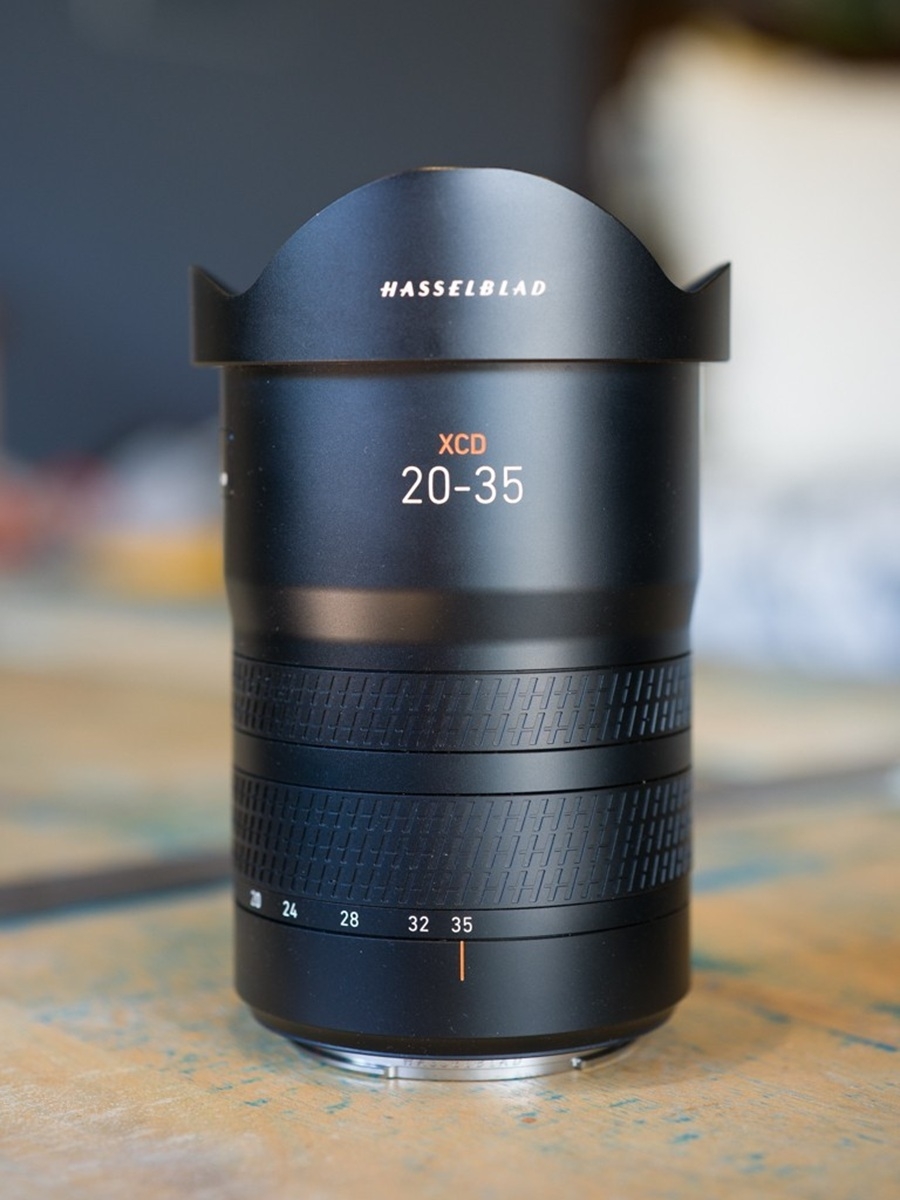
Hasselblad's medium-format wide zoom — the XCD 20-35mm f/3.2-4.5 E for the X system.
The Hasselblad XCD 20-35mm f/3.2-4.5 E was released in 2024 as part of the E-series of XCD zoom lenses for the Hasselblad X medium-format mirrorless system. It was among the first zoom lenses in the XCD range, which had previously been prime-only, and covers the ultra-wide to wide range on the X-system's medium-format sensor.
This is an autofocus Hasselblad X-mount medium-format zoom covering 20-35mm with a variable f/3.2-4.5 maximum aperture. As part of the E-series zoom line it uses a focal-plane-based exposure design rather than the leaf shutter found in the V and older prime lenses, so flash sync behaviour differs from those lenses. Confirm the exact weight, filter thread and minimum focus distance against the specific copy before listing.
On the larger medium-format sensor the 20-35mm range gives an ultra-wide to wide field of view suited to landscape, architecture, interior and travel work. A single zoom covering this range reduces the number of primes a landscape or architecture shooter needs to carry on the X system. The variable aperture reflects the design priority of covering a wide range in a manageable size rather than maximising speed.
As a recent lens the used supply is limited and prices remain high. Confirm the zoom and focus action is smooth and that autofocus drives correctly across the range. Inspect the front element and any filter thread for damage. Verify the lens reports and updates firmware correctly on an X-system body, and confirm which shutter behaviour it uses, as the E-series differs from the leaf-shutter lenses. Check the mount and contacts for wear.
Tracking the used Hasselblad XCD 20-35mm f/3.2-4.5 E price? Over the past week, the average has held steady at around £4699. Depending on age and condition, expect to pay between £4601 and £4704 for a used lens.